Across the northern seas and rolling steppes of Eastern Europe, a single decision in the late 10th century shifted the region’s trajectory for centuries. The Christianization of Kievan Rus’ was not just a spiritual pivot; it was a political gambit, a cultural doorway, and a catalyst for identity that would echo through later centuries of Russian, Ukrainian, and Belarusian history. This article unpacks the threads behind that turning point, traces the sequence of events as they unfolded, and looks at the enduring consequences that still inform the region’s religious and political landscape today.
Origins and causes
The roots of the christianization stretch back to a confluence of forces rather than a single moment of revelation. The lands around Kyiv and Novgorod had long hosted a mosaic of beliefs, with pagan rites woven into seasonal cycles and public life. Rulers faced a practical challenge: how to forge unity among straggling principalities, disparate tribes, and ambitious nobles who controlled different cities and trade routes. Christianity offered a framework for central authority, a shared calendar, and a legitimizing story that could underwrite a broader, more cohesive polity.
Beyond internal politics, the region’s growing contacts with the Byzantine world provided a powerful model and a realpolitik incentive. Byzantine culture had already traveled far north through merchants, diplomats, and travelers; its religious landscape offered a coherent structure—an organized church, a liturgy in a recognizable form, and a transcontinental system of political and spiritual authority anchored in Constantinople. Adopting Orthodoxy meant more than faith; it meant aligning with a pivotal international partner capable of boosting trade, diplomacy, and cultural exchange.
On a cultural level, the move toward Christianity promised literacy and learning. The church brought scribes, schools, and a new script—often associated with the broader spread of Cyrillic literacy—so that administration could be more efficient, law could be codified, and religious texts could be produced and circulated. For a society that thrived on trade routes and coastal towns, a written culture also meant better record-keeping, taxation, and governance. In short, belief and paper could work together to knit a larger, more durable state fabric.
Political motivations
Powerful princes in the region understood that religious unity could stabilize a fragmented realm. A single faith could solidify loyalty among rival aristocrats, reduce the risk of civil strife, and create a shared sense of purpose that transcended local factions. In this sense, the move toward Christianization was as much about state-building as it was about spiritual conversion. The church could serve as an imperial instrument—an apparatus through which a prince could claim legitimacy, direct resources, and frame law within a recognizable moral order.
Another layer involved diplomacy and prestige. Aligning with Byzantium carried practical advantages: support against common enemies, favorable trade terms, and access to a vast pool of religious and cultural capital. A Christian Russia could secure its boundaries more effectively, present a stable face to Latin Christendom, and participate in the broader Christian world as a recognized polity rather than a mosaic of rival factions on the periphery.
Religious and cultural factors
Religious ideas themselves mattered. Orthodoxy offered a sophisticated theological system, liturgy, and a calendar that could shape daily life, festivals, and civic rituals. For rulers, a Christian rite of passage for themselves and their people offered a way to redefine sacred time and communal memory. Pagan rites, though deeply ingrained, often stood in tension with centralized power and the new social projects leaders hoped to pursue. The church’s sacraments, clergy, and rites gave a structured way to mark milestones—births, marriages, deaths, and public feasts—under a single, widely recognized framework.
In addition, the personal story of Vladimir the Great (Vladimir I) looms large in the narrative of motivation. The prince’s marriage to a Byzantine princess and his exposure to Christian life in the Empire provided a concrete, human pathway from intrigue to conviction. His choice to embrace Christianity—albeit a complex, gradual process rather than a single instant—became a powerful symbol for a whole realm and a practical blueprint for future governance under a Christian order.
The course of events
The actual sequence of steps from private conversion to public adoption unfolded over a period that mixed decision, ritual, and political maneuver. The process combined personal revelation, dynastic diplomacy, and urban leadership. In this sense, the Крещение Руси: причины, ход событий и последствия phrase, spoken in some Russian and Ukrainian sources, captures a bundle of linked transitions rather than a single act.
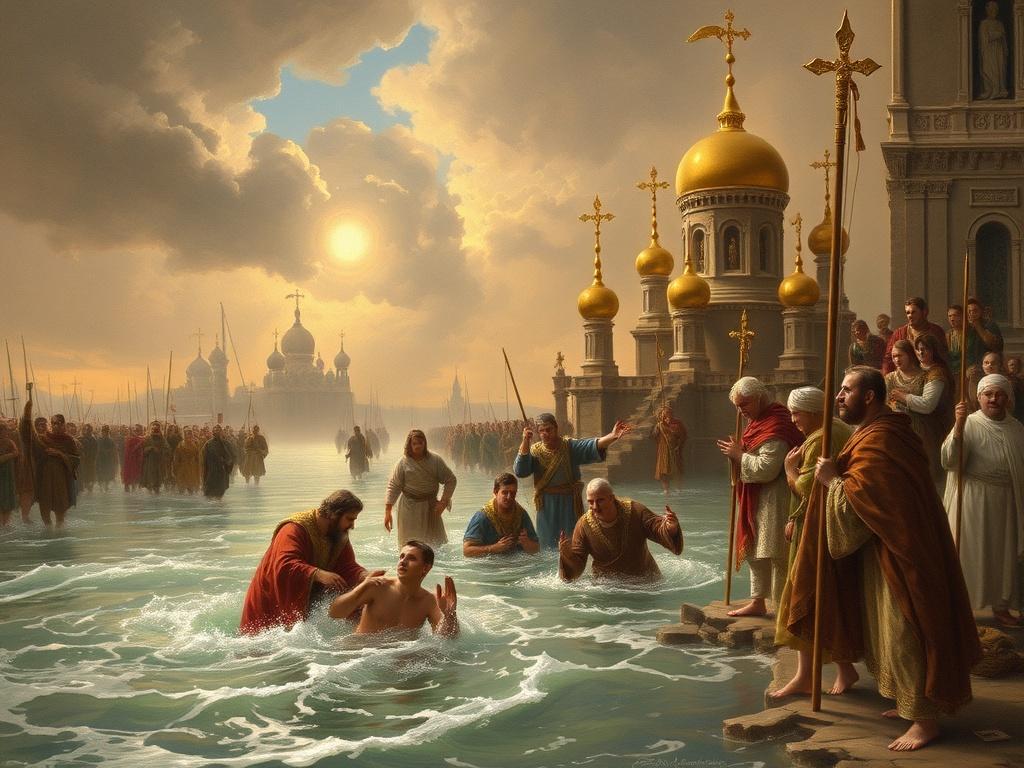
Central to the story is the pivotal year when Vladimir declared Christianity the state faith and orchestrated a public baptism. After aligning his family and court with Constantinople, he reportedly journeyed to the Byzantine capital to be baptized and to receive the blessing of Christian polity. Upon his return, the baptism did not stop with one ruler; it cascaded into the populace through a carefully choreographed program of mass baptisms—urban centers first, then the countryside, as bishops and priests spread out to administer the rite.
Rivers and churches became the theater of this transformation. The Dnieper, Kyiv, and other major towns were marked by ceremonies, the construction of churches, and the installation of clerical structures that could sustain the new faith. The clergy organized schools, established catechetical instruction, and began translating or composing liturgical books in the local languages. The move from pagan temples to Christian churches symbolized a new order in public life, law, and memory.
Vladimir’s decision and marriage to Byzantium
The personal decision of Prince Vladimir is a historical hinge. Accounts suggest a process of testing and dialogue, culminating in a choice that connected Kiev’s fate with the Byzantine imperial project. His marriage to a Byzantine princess—an alliance that brought prestige and access to Byzantine religious practice—helped to anchor the conversion in a real political alliance. This is not a fairy-tale moment but a carefully calibrated political outcome: a ruler bridging two worlds to secure a future for his realm.
With the ruler’s public conversion, the momentum switched from a selective adoption to a broader cultural turn. Christian symbols—baptismal fonts, churches, icons—moved from the margins to the center of public life. If the ruler’s faith was the spark, the church’s organizational capacity became the engine, enabling clergy to train local priests, supervise conversion efforts, and embed Christian norms within daily governance.
Baptism and church-building
The ritual of baptism went hand in hand with institution-building. The church’s hierarchy began to take shape, and bishops were installed in key cities to guide communities and enforce doctrinal unity. The new religious order required administrators, scribes, and liturgical specialists, all of whom helped to standardize worship and ceremonial life. Churches were not mere places of worship; they functioned as schools, archives, and centers of social welfare, where the state could project authority and the faithful could receive instruction and support.
The material transformation was striking. Old pagan sanctuaries often gave way to stone churches and monasteries, architectural symbols of a new cosmology. The presence of clergy, the creation of parishes, and the integration of religious festivals into the civic calendar yielded a shared rhythm that bound communities together—north, south, and east—under a single religious umbrella that also carried political implications.
Spread across the realm
Spread was uneven, as is typical with any large-scale religious reform. Urban centers with closer access to Byzantium and more developed administrative networks embraced Christian worship quickly, while rural districts adapted more gradually. Missionaries, bishops, and local clergy faced a mosaic of languages, customs, and local chieftains, all of which could slow or complicate the process. Yet the momentum was sustained by a steady stream of conversions, baptisms, and church-building projects that gradually reshaped the cultural map of the Rus’ lands.
Over time, Christian practice penetrated villages and towns alike, altering everyday life in profound ways. Feast days anchored agricultural cycles, and the church calendar began to structure labor, rest, and communal gatherings. Literacy spread with the need to read Scripture and write records, turning monks and clerics into builders of a durable cultural heritage that would outlive many political regimes.
| Year (approx.) | Event |
|---|---|
| 988 | Vladimir the Great proclaims Christianity as the state faith; baptism of Kyiv and initiation of mass conversions. |
| 990s | Expansion of Christian rites to major towns; establishment of early church structures and catechetical instruction. |
| late 10th–early 11th century | Construction of churches; growth of monastic life; development of a diocesan network under Byzantium influence. |
| 1051 | Metropolitanate of Kiev within the Byzantine church structure, reinforcing the Orthodox framework for the Rus’ lands. |
Consequences
The consequences of the baptism reached far beyond the ceremonial. A new religious order redefined political legitimacy, cultural production, and everyday life. The conversion helped to embed the Rus’ principalities into a wider Christian world, while simultaneously planting seeds for a distinctly East Slavic spiritual and cultural tradition. The long arc of these outcomes would shape how the region saw itself in relation to Byzantium, Western Europe, and the many neighbors to the east and south.
One of the most consequential changes was political realignment. The church emerged as a central institution in governance, providing a framework for law, education, and social welfare. Bishops and priests acted as moral authorities, counselors, and record-keepers, while monasteries became centers of learning and manuscript production. This institutional backbone supported centralized authority, helping princes coordinate policies across rival towns and territories. The church’s legitimacy often reinforced the ruler’s own prerogatives, weaving spiritual and political authority into a single tapestry.
Political and institutional changes
By aligning with Byzantium, the Rus’ rulers gained access to a broader political and diplomatic network. The Orthodox Church offered a familiar liturgy, caseload of religious practice, and an international audience that could vouch for their legitimacy on the world stage. In turn, local rulers could promise protection and endow the church with land and privileges, creating a reciprocal arrangement that stabilized their rule and promoted economic vitality through church-led networks.
The establishment of a recognized ecclesiastical hierarchy—bishops, archimandrites, priests, and scribes—also fostered administrative efficiency. Taxation and census-taking became more standardized, which supported royal governance. In the long run, this church-state synergy helped the Rus’ principalities navigate succession disputes, border management, and the pressures of expansion while presenting a cohesive cultural identity rooted in Orthodoxy.
Cultural and social transformations
The cultural landscape of the Rus’ transformed as liturgy, music, and art entered a new phase. Iconography and religious imagery carried ethical and theological messages that reinforced orthodoxy while shaping local aesthetics. Icon painters and carvers found patrons in princes and monasteries, and religious themes began to permeate everyday objects—wall paintings, frescos, and decorative elements on buildings and manuscripts alike.
Education and literacy followed the church’s needs. Scribes copied sacred texts, legal codes, and chronicles, creating a shared repository of knowledge that transcended local dialects and customs. Over time, this educated layer contributed to a more literate population capable of participating in civic life, negotiating legal agreements, and preserving the memory of communal achievements. The exchange with Byzantium and other Christian lands also brought new architectural forms, highlighting a shift in urban identity and public space.
Religious and geopolitical consequences
The adoption of Orthodoxy shaped religious life for centuries. The church provided a normative framework for moral conduct, ritual life, and the timing of festivals, linking local faith to a wider Christian orthodoxy. The external dimension—Eastern Orthodox communion with Constantinople and other patriarchates—embedded the Rus’ lands in a geographic and theological network that outlived many local dynasties and ethnic affiliations.
Geopolitically, the Christianization deepened ties with Byzantium while also gradually setting the Rus’ on a longer path toward eventual separate crystallization of East Slavic identity. The cross-cultural exchange brought challenges and opportunities alike: religious reform, liturgical standardization, and the potential for cultural friction with Western Christendom. In the long run, the Orthodox Christian framework would become a defining reference point for the region, influencing law, education, art, and devotion for generations to come.
Looking back, the Крещение Руси: причины, ход событий и последствия—when read as a whole—reveals a layered process: a strategic choice by a ruler, a religious movement with robust organizational power, and a cultural transformation that reshaped the aesthetic and intellectual life of the Rus’. It created a durable frame for identity that could adapt to shifting political tides, from the era of Kyiv’s dominance to the rise of Moscow and beyond. The baptism was not a single event but a turning of a wheel that broadened the horizon for a people and set them on a path that future generations would continue to negotiate and reinterpret.
From the vantage point of a writer who has studied regional histories and visited the churches, monasteries, and archives that bear witness to this era, the story feels less like a flawless chronicle and more like a living dialogue between faith, power, and everyday life. The ritual baptized a political project in a spiritual key, and that conjunction—between rulership and belief—created a durable template for what it means to rule, to belong, and to remember. The legacy continues to echo in how the East Slavic world envisions itself, its saints and its scholars, its cathedrals and its copies of Scripture, its calendar and its conscience.