The dawn of a realm in Eastern Europe blends legend with murmurings of history. The time between the arrival of the Varangians and the rise of Kiev as a political center was not a single leap but a slow, uneven building of power, trade, and identity. This is the story of how a handful of tribes and a Varangian ruler coalesced into a recognizable polity, a foundation myth that would shape the character of the region for centuries. What follows is an attempt to braid the available sources, the archaeology, and the practical realities that gave birth to an early state on the eastern edge of Europe.
Origins and legend: who was Rurik?
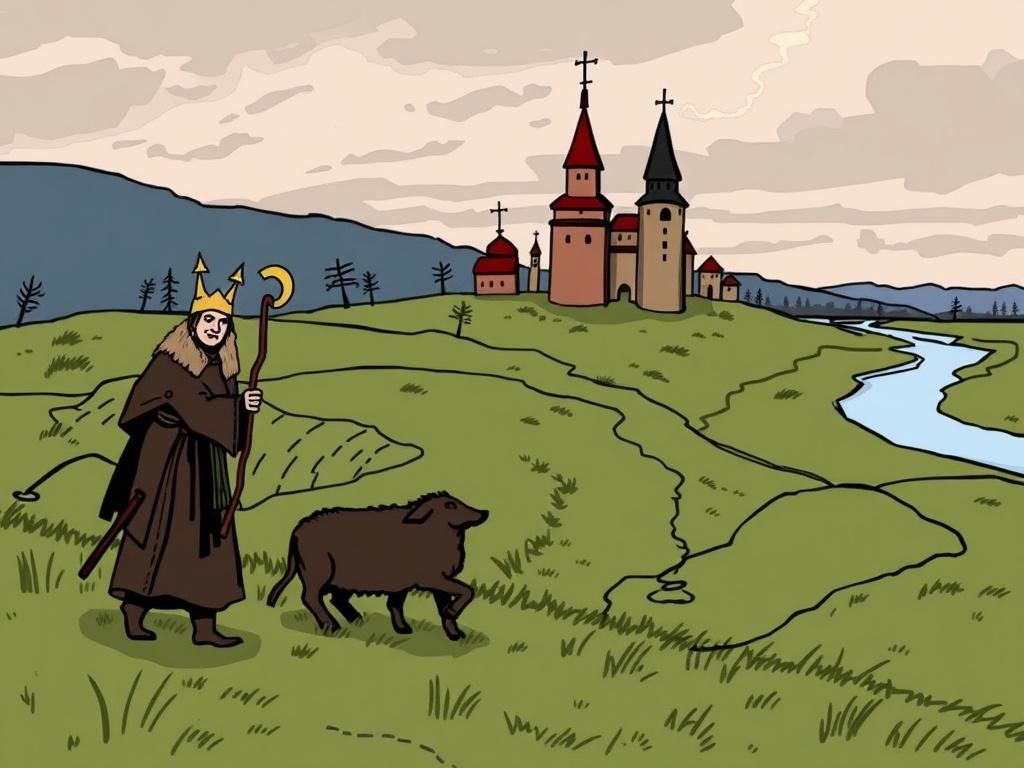
In the chronicles and later tall tales, Rurik sits at the dawn of Rus’ political life. He is described as a Varangian chieftain invited by the East Slavic tribes around Novgorod to bring order to a restless frontier. The core idea is simple and resonant: a strong leader arrives, unites, and curates a fledgling community into something larger than the sum of its parts. Whether this invitation happened precisely as the chronicles say or has been embellished by centuries of storytelling, the effect is clear—Rurik becomes the ancestral hinge of a line that would rule northern and eastern lands for generations.
Rurik’s position wasn’t a heroic conquest as much as it was the establishment of a stable center of gravity. The settlement at Novgorod—an inland port along the trade routes—grew into a political hub by necessity: people needed a locus to coordinate defense, regulate trade, and adjudicate disputes. It’s telling that the earliest durable institutions in this story are not grand palaces but assemblies, agreements, and the practical governance of a diverse and mobile population. For a writer or reader, the Rurikian moment invites you to imagine a tableau of rivers, fur traders, and the sort of pragmatic diplomacy that keeps candles lit in long northern winters.
Scholars still debate every detail, but most agree on a few durable threads: a Varangian ruler linked by kinship and alliance to local Slavic elites, a growing urban center at Novgorod, and the start of a dynastic line that would claim prestige, legitimacy, and the capacity to mobilize resources. The narrative of Rurik thus becomes less about a single conquest and more about the birth of a style of governance—one that blends foreign engineering with local contexts to create something new—a polity that could survive the volatility of the era.
Novgorod and the turning point: from scattered tribes to a polity
If Rurik’s arrival marks the dawn, Novgorod’s evolution marks the shaping of the body. The city sits at the crossroads of rivers and roads connecting the Baltic and the interior seas, a natural marketplace where goods, ideas, and people mingle. The nascent state benefits from this crossroads: traders come with tales and credits; craftspeople bring skills; and the local communities—Dregovichi, Ilmen Slavs, and neighbors—learn to coexist under a unifying authority. The result isn’t a single grand reform, but a pattern of governance that stabilizes exchange and cooperation.
Within this environment, the role of the prince gradually aligns with the needs of a trading federation. The ruler is not a mere warlord; he adjudicates disputes, marshals resources for defense, and negotiates with neighboring polities. The boyars—noble elites who draw strength from landholding, kinship, and service—become the scaffolding that supports a growing administrative system. The veche, the popular assembly, emerges as a counterbalance to regal authority in some locales, reminding everyone that political legitimacy in the early Rus often rested on a blend of consent and coercive power. The dynamic between centralized command and local autonomy will echo through centuries in the land’s political culture.
I’ve stood in places where the river meets the street, where the scent of fish and tar mixes with the ghost of markets long since moved elsewhere. The mental image helps me sense how a small group of families could turn a river port into a polity: it’s about infrastructure, trust, and the shared habit of making trade and dispute resolution work. A city that can manage a good harbor, an orderly system for collecting tribute, and a stable line of succession becomes a magnet for others who want the security and opportunity that a-rooted authority promises.
Veche and governance: the uneasy balance of power
One of the most intriguing features of early Rus’ polities is the tension between royal prerogative and communal voice. The veche—an assembly where free men could gather to discuss major decisions—offered a way for commoners and local elites to influence policy. This did not create a pure democracy, nor did it deny the prince the ultimate say; rather, it established a culture in which policy had to withstand scrutiny and persuasion. It’s in this friction that the political character of early Rus is most visible: legitimacy arises from the ability to mobilize people, not simply from a single victor’s will.
But the gubernatorial model remains heavy with practical constraints. The prince’s ability to levy tribute, maintain foreign alliances, and mobilize the druzhina—his retinue and household soldiery—carried the day when resource or strategy demanded. The early state thus resembles a mosaic of centers—Novgorod, Kiev, and other holdings—each with its own rhythm, yet bound by common rules of kinship, shared trade routes, and a pragmatic, often opportunistic, diplomacy. This is not a sudden leap into centralized monarchy; it is a cautious, iterative forging of a political identity that could command disparate communities toward shared goals.
From a storytelling perspective, this period offers a vivid lens on governance: power under construction, not perfection, with a continuous negotiation between those who prize local rights and those who seek a stronger, more unified command. The drama is in the everyday acts—the sending of ambassadors, the resolution of skirmishes along a river bend, the ritual of tribute collection—rather than in a single climactic battle. And yet those everyday acts, scaled and repeated, create a sense of a larger, enduring project: a state that could sustain itself through seasons of scarcity and surplus, war and peace.
The ascent of Oleg: moving the capital and expanding the realm
Oleg the Prophet, as he is sometimes called in chronicles, enters the narrative as a figure who translates the scattered strength of the early Rus into a concerted direction. He is credited with conquering or at least seizing the key city of Kiev around the late 9th century, then binding it into the orbit of Novgorod’s power and prestige. The move to Kiev matters for two reasons: it creates a central hub on the Dnieper trade route that can coordinate the north with the south, and it births a new capital that would carry the prestige of the Rus’ leadership into future generations.
The capture and stabilization of Kiev—often dated around 882 as a turning point in the consolidation of the Rus’ political sphere—reframes the region’s geography of power. The Dnieper River becomes the main artery for goods, people, and ideas moving between the Baltic and the Black Sea. Oleg’s expansion is not merely military; it is administrative and diplomatic: he stitches together diverse tribes and micro-polities into a coherent system of tribute, exchange, and mutual defense under a single ruler with the modified title of knyaz (prince).
From a writer’s standpoint, Oleg’s story is a hinge moment because it demonstrates how a polity can transition from a riverine coalition to a capital-centered state. The image of Kiev rising from the river’s edge, walls rising, markets opening, ambassadors coming from Byzantium and the steppe, gives the era a tangible sense of scale. The political imagination shifts with this move: a city becomes a symbol of unity, a place where laws, treaties, and rituals can be performed with public spectacle and permanence.
Economy and diplomacy: trade routes breathe life into the state
Trade is the quiet backbone of early Rus’ state formation. The route from the Varangians to the Greeks—heavy with amber, furs, slaves, and, later, coins—links northern territories with Constantinople and the wider Byzantine world. This network does more than move goods; it transmits ideas, technologies, and legal concepts. A ruler who can protect caravans, regulate customs, and establish neutral zones along the rivers gains a lever to stabilize his rule without constant military campaigns.
The economic logic of the era pulls in multiple directions at once. There is a need to secure tribute and defend trade posts; there is a desire to cultivate prestige through gifts, marriages, and diplomatic alliances with neighbors such as the Khazars, Pechenegs, and later the Byzantines. The result is a political economy in which a prince’s legitimacy rests on both the ability to defend and the skill to govern the exchange that keeps his people fed and his neighbors respectful. The currency of power here is not only bronze or silver but trust, reliability, and the capacity to read a shifting map of alliances.
As someone who likes to trace the threads of history, I find it compelling how an economy built on rivers and ports can shape political culture. The merchants’ voices—carriers of risk, credit, and rumor—become a counterweight to the warriors’ demands. The state’s legitimacy grows not just from the sword but from the reliable movement of goods and the protection of traders who would otherwise risk everything for the chance of profit. This is where the early Rus begins to look and feel more like a true state and less like a loose confederation of towns.
Religion and cultural codes: sacred ground before Christianization
The spiritual life of the early Rus is a patchwork of pagan rites, reverence for natural forces, and a gradual openness to external influence. The Norse-derived heritage of the Varangians mingles with Slavic beliefs in a pantheon of deities tied to the land—Perun, Veles, and a host of lesser spirits who preside over thunder, grain, and rivers. Temples, shrines, and sacred sites punctuate the landscape, giving a religious texture to state-building: the rites enacted in public spaces, the seasonal ceremonies marking sowing and harvest, and the rituals that invite legitimacy through the favor of the gods.
Diplomacy and faith intersect in a crucial way as well. The Byzantine Christian world, with its sophisticated statecraft, provides models for ceremonial dress, imperial presents, and diplomatic rituals. Olga of Kiev—who would later pursue Christianization through a mix of kinship ties and strategic diplomacy—makes the first notable cultural hinge toward a Christian future, even if the formal conversion and widespread adoption come later. It’s a reminder that religious change often travels in tandem with political consolidation, rather than arriving as a single, sudden event.
For a writer, these beliefs aren’t simply background; they shape decisions, court ceremonies, and the symbolism that legitimizes authority. The prince’s power is reinforced by ritual acts that bind the people to a common story, by prodigious gifts to kings and monks that signal openness to a broader Christian world, and by the slow, painstaking process of aligning religious practice with political needs. The era is a vivid canvas where faith and sovereignty walk side by side, each reinforcing the other as the realm grows.
Legacy and transition: setting the stage for Igor and Olga
By the time Oleg’s dynasty cements its hold over Kiev and Novgorod, the Rus’ state has moved beyond the glitter of heroic deeds. It has grown into a framework of governance, trade, and diplomacy that can absorb shocks—from raids to famine—without collapsing. The next chapters—Igor’s rule, Olga’s reforms and Christianization, and the long arc toward the accession of Vladimir the Great—will build on this foundation. But the essential character of the earliest phase remains: a political culture that learned to unite diverse peoples under a common banner while preserving essential local identities and commerce.
The early state’s institutions—dynastic legitimacy, the prince’s druzhina, the counsel of local elites, and the veche in some communities—remain flexible enough to adapt to changing conditions. This adaptability is its most enduring strength. It explains why the Rus could survive and flourish across centuries, even as external pressures and internal rivalries persisted. The story from Rurik to Oleg thus reads as a preface to a larger history—the slow-woven fabric of a state that would evolve, splinter, and re-form again and again in the centuries ahead.
As a writer who has walked old riverbanks and imagined the markets of medieval towns, I find that the most persuasive image is not the grand ceremony but the routine act—a council convened to settle a border dispute, a caravan guided through a hazard-filled corridor, a tribute paid in the coins that travel along the river. These ordinary moments accumulate into a national life, and they offer a way to sense how an early Rus state could suddenly feel both intimate and vast—a community of people bound by shared memory and emergent law, with a future that was only just beginning to be written.
Table: a quick look at milestones on the road to Kyiv
| Date (approx.) | |
|---|---|
| 862 | Rurik invited to rule Novgorod; legendary start of a ruling dynasty. |
| 879 | Rurik dies; succession continues the dynastic line. |
| 882 | Oleg campaigns north and moves to control Kyiv; capital moves toward strategic center. |
| 907/911 | First Byzantine treaties and campaigns, signaling expanded diplomacy and trade. |
| 930s–940s | Increasing integration of diverse tribes and towns; seeds of centralized authority. |
People and power: key figures beyond Rurik and Oleg
In any attempt to map the birth of a state, a few names anchor the story beyond the central figures. Igor, Oleg’s successor, inherits a system stretched across a widening geography. Olga, his wife and later ruler in her own right, embodies the transformation from a homeland defense to a more formalized legal and religious reform program. Their roles illustrate how leadership in this era depended as much on partnerships—marital alliances, kinship networks, and diplomatic ties—as on battlefield prowess. The early Rus was a network, not a solitary monarchic achievement.
The internal governance reflects a pragmatic blend of authority and consent. The prince could marshal resources for defense and diplomacy, yet the veche and local assemblies—when they functioned—acted as a check on unilateral rule. The result is a political culture that values both strength and legitimacy earned through negotiated settlement. Writers and historians often highlight this balance because it helps explain how a relatively small core could hold together a sprawling frontier for generations.
From a personal vantage point, I like to picture these leaders not as distant mythic giants but as people navigating a political weather system. They have to read the winds of the steppe but also the currents of trade on the Dnieper. They must translate the demands of the countryside into a policy that works at court. This mix—resourcefulness, kinship, and negotiation—feels like a timeless component of statecraft, even when the map looks very different from ours.
Statehood as a living project: how the early Rus learned to govern
The emergence of a recognizable state in this region didn’t rely on a single miracle. It came from continuous adaptation: securing river routes, mediating disputes among diverse tribes, and offering protection to merchants and farmers alike. The prince’s role gradually included more institutional tasks: designing tribute systems, negotiating with foreign powers, and allocating land and labor in ways that kept the realm functional. In this sense, the early Rus state mirrors many comparable frontier polities—founders step aside, a ruling class stabilizes, and a customary law begins to take shape.
Crucially, the state’s grammar—the way people spoke about authority, justice, and obligation—was being written as the polity encountered new neighbors and new pressures. The Byzantines offered models of diplomatic ceremony and legalities; Turkic and steppe groups introduced mobility and risk; and local communities contributed practical norms about neighborliness and fair dealing. The result is a cultural and political syncretism that would define the region’s character for centuries. If you tilt your ear toward the rivers, you hear a chorus of languages and traditions learning to listen to each other.
As someone who loves to reconstruct a historical scene, I’m drawn to the way governance in these times fused everyday practice with grand aspiration. A tax collector, a warrior, a local elder, and a traveling ambassador all played roles in a single, living system. The borders were not yet fixed lines on a map but a web of obligations and commitments that could shift as needed. This elasticity—combined with a practical instinct for defense and trade—explains how the Rus managed to endure in a volatile environment and set the stage for the next chapters of their history.
Real-life echoes: how we read the roots of statehood today
Historians remind us that the sources for this period are partly legendary, partly documentary. Chronicles like the Primary Chronicle blend anecdote with record, and archaeological finds corroborate certain patterns of settlement, fortification, and artifact distribution. The challenge for modern readers—and for writers like me—is to separate what can be attested from what must be interpreted. The goal is not to erase myth but to place it in a credible context where it helps illuminate social memory and political imagination.
When I study these early chapters, I’m struck by how much of the state’s strength comes from ability to connect people across distance. Trade routes knit towns together; shared rituals and symbols knit communities together even when leaders changed. The road from Rurik to Oleg is thus less a straight line than a braided path—one where lineage, geography, commerce, and faith all contribute to a durable, evolving political organism. And that living organism is exactly what makes the earliest Rus state feel not only ancient but still resonant today.
In closing this part of the journey, it’s worth noting that the story doesn’t end with Oleg’s expansions. It simply marks a threshold: a polity with a capital, a recognized ruler, and a workable system for managing wealth, defense, and exchange. What follows in the historical record—the maturation under later rulers, the cross-cultural exchanges with Byzantium and the steppe, and the enduring memory of Kyiv as a political heart—emerges from this foundational moment. The birth narrative is, in other words, a prologue to a long story about a people and their land.